INTRODUCTION

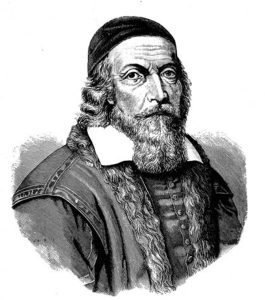
Actuality of theme. Jan Amos Comenius is a Czech theologian, thinker, teacher, writer, author of such notable works as “The Great Didactic”, “Mother’s School”, “The World of Sensible Things in Pictures”. Komensky’s great merit was that he was the first to collect and systematize all the information from pedagogy, and also developed revolutionary ideas at that time, in particular, the idea of the class-lesson system belongs to these. Comenius believed that education should be started as early as possible, that the educational material must necessarily correspond to the age of the students, and he was convinced that the human mind is capable of grasping anything.
Only this requires consistent and gradual progress in education, following the immortal and universal didactic rules: “from near to far”, “from the whole to the separate”, “from the familiar to the unfamiliar” so that students learn the system of knowledge, and not fragmentary information. Comenius also believed that it is necessary to develop positive ethical traits from childhood (justice, moderation, courage; it is interesting to note that by the latter he also understood perseverance in work). The teacher used the example of adults to systematically accustom children to useful activities and to follow the rules of behavior. Along with the traditional “seven liberal arts”, Comenius introduced natural science, history and tageography into the gymnasium curriculum.
MAIN PART
1. Pedagogical system of Ya. A. Comensky
Jan-Amos Comenius (1592-1670) was the founder of scientific pedagogy, an outstanding Czech thinker. He lived and worked during the period of transition from the Middle Ages to the modern era, which was characterized by the struggle between feudalism and capitalist elements that were emerging and rapidly developing.
Comenius’ pedagogical views and pedagogical activity were characterized by democracy, humanism, cheerfulness, religiosity — the recognition of God as the first cause of the appearance of nature and man; sensualism, according to which the beginning of knowledge is feeling, experience. In his worldview, sensualism came into conflict with religiosity, democracy, enlightenment, which led to the duality of the scientist’s approach to the main issues of pedagogy.
Comenius’ pedagogical heritage covers all the most important issues of pedagogical science. But above all, the ideas that determine the need for education and upbringing at school stand out. According to them, boys and girls, poor and rich, should study at school. In the process of education, a person learns to know himself and the surrounding life (mental education), to control himself (moral education), to believe in God (religious education). The future of the state and people depends on how education, training and upbringing of the younger generation is organized.
Considering a person to be a part of nature, Comenius notes that his upbringing must take into account the laws of nature, that is, be in accordance with nature. This principle became the methodological basis of his interpretation of the process of education and upbringing and the construction of the school system. He was the first in the world to rise to the awareness of special laws in education and training. Subsequently, other pedagogues approached this principle from different positions, and it is still used today in modern progressive pedagogy. Ya. A. Comensky introduced the age periodization of children’s development and, according to it, the system of school education and its content.
Ya. A. Comensky is considered the father of didactics. For the first time, he created a thorough teaching about the essence, the basic principles and methods of learning, and the class-lesson system. In the “Great Didactics”, the scientist defined the essence and tasks of education, which is designed to serve a person for the improvement of his mind, speech and hands, so that he can intelligently contemplate, express in words and implement in action. Comenius advocated the encyclopedic nature, comprehensiveness and expediency of the content of education, the unity and continuity of schools of all types, and proposed a concentric method of placing educational material. In his works, he substantiated the main principles of learning: clarity, consciousness, strength, consistency and systematicity, strength, emotionality. In his opinion, their observance will make learning easy, thorough and short.
The scientist introduced the concept of the academic year with its division into quarters and vacations, introduced transfer exams at the end of the year, various types of control and verification of students’ performance, reflected on the organization of the academic day at school. His great merit lies in the fact that he introduced the classroom-class system of education; demanded to start studies in schools every year on the same day and time; carefully distribute educational material by years of study, simultaneously teach a certain number of students (class) and transfer them from one class to another. The classroom system of teaching has been established in schools all over the world.
Для отримання повного тексту придбайте роботу!
Реферат "Україна в процесі переходу до сталого розвитку. Цілі сталого розвитку"
Реферат " Графічний дизайн "
Реферат "Організаційний стрес та профілактика й подолання синдрому (професійне вигорання) в організації" 

Відгуки
Відгуків немає, поки що.